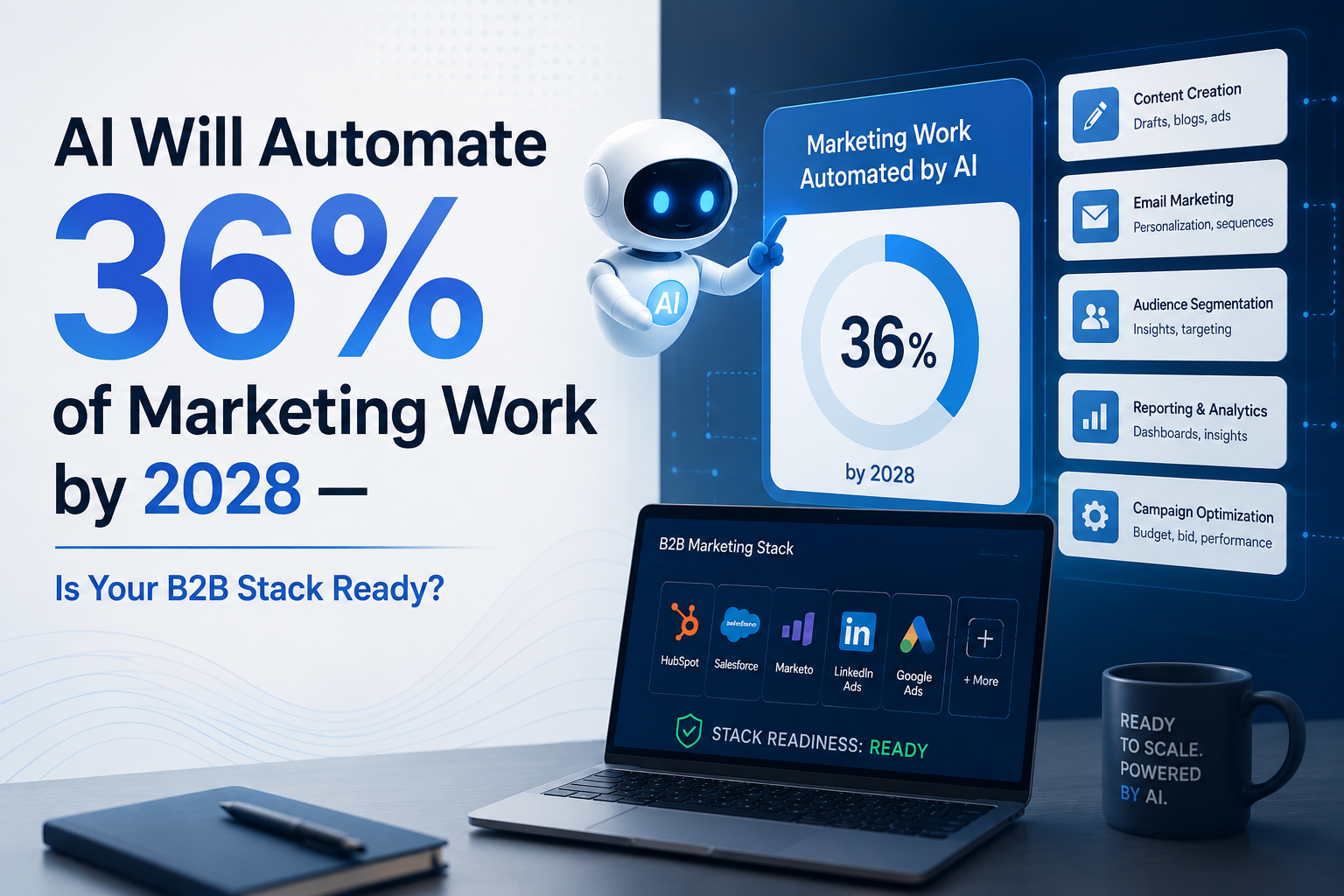
Gartner dropped a number earlier this month that every marketing leader should have in their back pocket: AI-driven automation will handle 36% of all marketing work by 2028 — more than double the 16% it handles today. That's not a long-range prediction. That's a two-year runway. And for B2B teams still managing campaigns manually, patching together disconnected tools, or waiting for "the right time" to invest in automation, the clock is already ticking.
The question isn't whether this shift is coming. It's whether your stack — your data, your processes, your team — is positioned to capture the upside or get left behind by competitors who move first.
What Gartner's Data Is Actually Telling Us
The headline number is striking, but the more important signal is the rate of change. Going from 16% to 36% in two years isn't gradual adoption — it's a step-change. Gartner's research points to three converging forces driving this acceleration:
- Agentic AI maturity: AI systems can now execute multi-step workflows autonomously — not just recommend actions, but take them. Campaign optimization, lead routing, email sequencing, and CRM updates are all within scope today.
- Platform consolidation: Major CRM and marketing automation vendors have embedded AI deeply enough that teams no longer need separate AI tooling — it ships with the stack they already pay for.
- Compounding ROI data: AI-driven campaigns are now showing an average 22% higher ROI than traditional methods. As those results accumulate, budget allocation follows.
The Hidden Bottleneck: Why AI Ambition Stalls at Data Quality
Here's what the headline stat doesn't tell you: for many B2B teams, the ceiling on AI performance isn't the AI — it's the data feeding it. A recent industry survey found that 47% of B2B marketing and sales teams cite lead and data quality as their primary barrier to AI adoption. Another 36% flag inconsistent sales follow-up as the drag on pipeline performance.
No AI model — however sophisticated — can produce reliable lead scores, accurate attribution, or meaningful personalization from dirty data. If your CRM contains duplicates, stale contacts, inconsistent field values, and gaps in firmographic data, deploying AI on top of it amplifies those problems rather than solving them.
"AI-powered personalization requires clean, unified customer data. Without it, you're not scaling personalization — you're scaling inconsistency."
Before your team can capture the 36% figure Gartner is projecting, the foundational work has to happen first. The good news: it's not as daunting as it sounds when you approach it in the right order.
The 3 Foundations That Make AI Automation Viable at Scale
Teams seeing the biggest AI returns right now share three things in common. None of them require a full platform overhaul — they require discipline in how the existing stack is managed.
1. A unified contact record. Your CRM should be the single source of truth for every customer and prospect. That means deduplication runs regularly, data from your website, marketing automation, and support tools syncs cleanly, and every contact has a consistent set of core fields populated. AI scoring and segmentation only work as well as the underlying record quality.
2. Defined lifecycle stages tied to real behavior. Most CRMs have lifecycle stages — MQL, SQL, Opportunity — but many teams have let them drift from their original definitions. Cleaning this up isn't a technical task; it's a sales-marketing alignment task. When lifecycle stages accurately reflect where buyers actually are, AI can model the path to close with real predictive power.
3. Connected attribution across channels. If you can't trace a closed deal back to the campaigns, content, and touchpoints that influenced it, your AI is optimizing blind. Setting up multi-touch attribution — even at a basic level — gives AI models the signal they need to allocate budget and effort toward what actually drives revenue.
Where B2B Teams Are Winning With AI Right Now
The 16% of marketing work currently automated isn't spread evenly. It's concentrated in specific workflows where AI has clear, measurable advantages over manual processes. Here's where the clearest wins are happening for B2B teams today:
- Email sequence optimization: AI is dynamically adjusting send times, subject line variants, and follow-up cadences based on individual engagement patterns — not static rules.
- Predictive lead scoring: Models that pull from CRM history, intent data, and behavioral signals are surfacing pipeline-ready leads that static scoring would have missed or delayed.
- Ad budget reallocation: Automated rules tied to conversion data are shifting spend toward high-performing audiences in real time, compressing the feedback loop from weeks to hours.
- Content personalization: Website and email experiences that adapt by industry, company size, and funnel stage are shortening the time from first visit to demo request.
Your 90-Day Action Plan
If the Gartner timeline feels aggressive, it helps to break it into a near-term sprint. Here's what to prioritize in the next 90 days to build toward meaningful AI automation in your stack:
- Week 1–2: Audit your CRM data quality. Run a deduplication report, identify gaps in core fields, and document the last time lifecycle stage definitions were reviewed.
- Week 3–4: Map your current automation coverage. Which workflows are already automated? Which high-volume, repetitive tasks are still manual? Prioritize the ones with the most time cost.
- Month 2: Enable AI features you're already paying for. Most HubSpot and Salesforce subscriptions include AI capabilities that are turned off by default. Turn them on, configure them against your data, and baseline the results.
- Month 3: Close the attribution gap. Set up even a basic multi-touch attribution model so you can begin feeding your AI tools real signal on what's converting — not just what's clicking.
Thirty-six percent of marketing work handled by AI in two years sounds ambitious. For teams that start now, it's achievable. For teams that wait, it's the gap their competitors will be working with.
Ready to build an AI-ready marketing stack?
Book a free 30-minute strategy call. We'll audit your current setup, identify your biggest data gaps, and map out a clear path to meaningful AI automation — no pitch, just a plan.
Book a Free Strategy Call